
Emerging trends in business strategies and marketing for this 2023-2024

2024 promises to be an exciting year for sales and marketing, with new technologies and approaches emerging that will enable companies to deliver a more personalized and effective customer experience. Therefore, we will analyze some emerging trends in business strategies and marketing for this year.

The biggest trend we are seeing is that companies are becoming more and more customer-centric. As customers become more demanding, it is important that companies provide them with the products and services they want.

Perspectives in business strategies and marketing

In the next five years, companies will focus on building long-term relationships with their customers, offering them better products and services at lower cost. This means that the customer experience is critical and must be considered in all aspects of businesses.

In a recent Forrester Research study, 80% of B2B buyers said they would stop doing business with companies that did not provide a great customer experience. Businesses that offer remarkable experiences will be rewarded with loyal customers who will recommend them to others and spend more money over time than those that don’t offer a seamless experience.

Customers no longer like to be treated like numbers, they want to be treated as individuals. Personalization means giving customers exactly what they need and want at every step of their journey through your website or app. This can be something as simple as offering them a discount if they share their email address. Or something more complex like offering them different options based on where they live or what device they use to access your website or app. It’s all about personalizing the experience so that it feels like it’s designed just for them.

• The rise of AI-powered marketing automation: Artificial intelligence (AI) has been around for decades, but it’s only recently that companies have begun to integrate it into their marketing strategies. By 2024, AI will be used by 80% of B2B companies to personalize their campaigns, create better content and increase ROI.

• Social networks as a sales tool: social networks are no longer just a place where people share photos and videos or comment on other people’s posts, but have become a valuable sales tool for companies that want to interact with your audience before they even get in touch with them by email or phone.

Competitive edge

As the global economy continues to evolve, businesses must stay ahead to remain competitive and successful. This includes understanding how business strategies, marketing strategies, and other trends will affect your operations. By having a clear understanding of these trends, companies can ensure that they are prepared for any changes that may arise in the future.

For this reason, we cannot lose sight of the fact that the digital revolution will continue apace. Technology will become more advanced, consumers will demand more from brands, and people will stay even more connected than ever before.

What are those emerging trends?

These are some of the trends that we foresee will be present in business and marketing strategies by 2024, among which the following stand out:

1. Content Marketing: Content marketing continues to be a key strategy to generate engagement and loyalty among consumers. In 2024, brands are expected to continue producing quality, relevant content adapted to the different channels and formats, such as videos, podcasts, and infographics, among others.

2. Personalization: Consumers increasingly expect a more personalized experience, and brands are embracing technology and tools to offer personalized products and services in real-time.

3. Artificial Intelligence: AI is transforming the way companies do business, and brands are expected to continue investing in this technology to improve efficiency, personalization, and customer experience. AI can also be used to improve audience segmentation and purchase behavior prediction.

4. Omnichannel: Consumers expect a seamless and consistent shopping experience across all the channels they use, from physical stores to social media. This indicates that brands continue to adopt an omnichannel strategy to improve the customer experience and increase retention.

5. Sustainability: Sustainability continues to be a major concern for consumers and in 2024, brands must continue to adopt sustainable practices in their supply chain, production, and distribution. Companies can also use sustainability as a competitive differentiator.

6. Influencer Marketing: Influencer marketing continues to be a relevant trend for brands looking to reach specific audiences and build trust in their products and services. In 2024, influencer marketing is expected to continue to evolve toward more authentic and lasting relationships between brands and influencers.

7. Marketing automation: Marketing automation allows companies to make the lead generation process and campaign management more efficient and effective. Investing in marketing automation tools to improve the efficiency and effectiveness of your campaigns will be an irreversible trend.

8. Augmented and virtual reality: Augmented and virtual reality are being increasingly used by brands to improve the customer experience and increase interaction with their products and services. For example, some stores are using augmented reality to allow customers to virtually try on items like clothing and makeup before buying. In the case of virtual reality, some brands are creating immersive experiences for their customers, allowing them to virtually explore their products and services in a simulated environment.

9. Conversational commerce: refers to the use of chatbots and virtual assistants to interact with customers and facilitate purchase and support. Additionally, chatbots can be programmed to learn from customer interactions, improving their ability to provide accurate and helpful responses over time.

10. Immersive brand experiences: are those that seek to involve customers in an experience that goes beyond the simple purchase of a product or service. This technique can generate greater engagement and loyalty in your customers. For example, some brands are creating physical or virtual installations that allow customers to interact with their products and services in a unique and memorable way. These experiences can be shared on social networks and generate greater reach and engagement with the brand.

11. Values-Based Marketing: More and more consumers are looking for brands that share their values ??and social and environmental concerns. In 2024, companies are expected to continue to take a more conscious and sustainable approach to their business practices and to effectively communicate this to their customers. Brands can use their commitment to sustainability, social justice, or gender equality to differentiate themselves from the competition and build a deeper, more meaningful relationship with their customers.

12. Voice Marketing: With the rise of virtual assistants and voice recognition technology, voice marketing is emerging as a new way to interact with customers. Brands can use voice to provide product recommendations, make reservations, or answer customer questions. Additionally, brands can use voice to create personalized brand experiences, using the tone of voice and language that best suits their target audience.

In a recent Accenture report, it is mentioned that “the digital age has reached a point where it affects all aspects of our lives”.

As companies evolve and adapt to changing environments, so must their strategies. To succeed in business, it is essential to keep pace with changing times. Companies that do not adapt their strategies and practices to the latest trends run the real risk of falling behind the competition.

New technologies are transforming the way companies do business. It is important that customers are aware of the latest innovations in their area of ??business. You must be willing to experiment and try new tools and technologies to improve efficiency, personalization, and the customer experience.

Understanding these trends is essential for any business looking to continue to succeed for years to come.


Diseño sin título (41)

The power of outsourced marketing services and how can help a business grow

Outsourced marketing services allow businesses access to experts in their field who can help them create content that resonates with their customers, optimize their campaigns for maximum efficiency, and develop strategies that generate more leads and conversions. With these services, companies can focus on what they do best and leave the rest of the work to professionals who specialize in marketing.

The power of outsourced marketing services lies in their ability to provide expert guidance and support for all your marketing needs. With a team of experts on hand, you can ensure that all aspects of your marketing campaigns are handled correctly and efficiently.

What is the outsourcing of marketing services?

The outsourcing of marketing services, also known as marketing outsourcing, refers to the contracting of third parties specialized in marketing to carry out activities related to the promotion of a company’s products or services. In this business model, a company hires a marketing agency or marketing service provider to perform specific marketing-related functions, such as social media management, content creation, online advertising, and research market, among others.

Marketing outsourcing has become increasingly popular among businesses as it allows them to access specialized skills and knowledge without having to invest in hiring in-house staff or purchasing expensive marketing technologies and tools.

In addition, it allows companies to continue operating in their core business and other critical activities, while marketing service providers are in charge of planning and executing effective marketing strategies.

What benefits do companies obtain when outsourcing marketing services?

Outsourcing marketing services can provide various benefits including:

Cost reduction: By outsourcing marketing services, companies can save on staffing costs, training, infrastructure, and equipment. Instead of having an in-house marketing team, they may hire an outside agency that already has what it takes to carry out marketing activities.

Access to experts: Marketing agencies usually have a team of experts in different areas of marketing. Like advertising, public relations, digital marketing, market research, among others. By outsourcing marketing services, companies can access this specialized knowledge without having to hire in-house experts.

Flexibility: By outsourcing companies can easily adapt their marketing strategies as market needs or business objectives change. If more staff or resources are needed, the outside agency can quickly provide them.

Quality improvement: By hiring an experienced marketing agency, companies can improve the quality of their marketing campaigns. Marketing agencies often have tools and resources that allow them to run high-quality campaigns that can help businesses improve their brand image and attract more customers.

Time savings: By outsourcing marketing services, companies can save time planning, implementing, and monitoring their marketing campaigns. This allows them to focus on other areas of their business and be more efficient overall.

What type of marketing services are the most common to outsource

There are various marketing services that companies can outsource, some of the most common include:

1. Graphic design and creativity: Companies can outsource graphic design and creativity services, such as logo creation, packaging design, and design of advertising materials, among others.

2. Advertising: Companies can outsource advertising services, such as the planning and execution of advertising campaigns in mass media, online advertising, and advertising on social networks, among others.

3. Public Relations: Companies can outsource public relations services, such as reputation management, crisis management, and the creation and distribution of press releases, among others.

4. Digital Marketing: Companies can outsource digital marketing services, such as website creation and management, SEO strategies, email marketing campaigns, and online advertising, among others.

5. Market research: Companies can outsource market research services, such as surveys, market studies, and data analysis, among others.

6. Events and promotions: Companies can outsource events and promotions organization services, such as trade fairs, product launches, and promotions at points of sale, among others.

In general, any marketing service that is not a core business activity or that requires specialized skills or specific resources can be outsourced. It is important for businesses to carefully assess their needs and choose a trusted and experienced marketing agency to ensure they get the desired results.

What are the benefits of outsourcing marketing services instead of doing them in-house?

Outsourced marketing services offer a number of important benefits for businesses. Including cost reduction, access to experts, flexibility, quality improvement, and time savings. Other additional ones are the following:

Greater scalability: Companies can increase or decrease the amount of marketing services they need based on their needs, without having to worry about hiring or firing internal staff. Marketing agencies can provide the resources needed to accommodate these fluctuations in demand.

Better measurement of results: Marketing agencies often have the tools and experience to measure and analyze the results of marketing campaigns. By outsourcing marketing services, companies can gain a better understanding of the results of their marketing campaigns and make more informed decisions going forward.

Risk reduction: Businesses can reduce the risk of costly mistakes in their marketing campaigns. Marketing agencies have experience creating and executing successful marketing campaigns. This reduces the probability of errors and increases the effectiveness of the campaigns.

What are the trends and best practices in outsourced marketing services for 2023

Regarding trends, the most relevant in the field of outsourced marketing services can say:

1. Increased use of automation technologies: Automation of marketing processes has become increasingly common. Marketing automation tools help businesses automate tasks like sending emails, scheduling social media posts, and content personalization.

2. Increased focus on customer experience: Companies are realizing that customer experience is a key factor in marketing success. Therefore, they are looking to outsource marketing services that focus on improving the customer experience.

3. Increased use of data analytics: Companies are using more and more data to inform their marketing strategies. Companies that outsource their marketing services look for providers who can help analyze and use data effectively.

Regarding good practices, some recommendations are:

1. Set clear objectives: Before outsourcing marketing services, it is important to have clear objectives in mind. This will help ensure that the selected vendors can meet the company’s goals.

2. Open and frequent communication: Communication is key to a good relationship with marketing service providers. It is important to maintain open and frequent communication to ensure that objectives are being achieved and to address any issues that may arise.

3. Careful selection of suppliers: It is important to select suppliers carefully to ensure that they have the necessary experience and skills to meet the objectives of the company. It is also important to make sure that the providers have a good reputation and references.

4. Set Clear Expectations: It is important to set clear expectations with marketing service providers. This includes setting deadlines, deliverables, and any other relevant information.

5. Measure success: It is important to measure the success of outsourced marketing services to ensure that the objectives of the company are being met. This can also help inform future decisions about outsourcing marketing services.

What metrics are suggested to measure the success of outsourced marketing services?

There are various metrics that can be used to measure the success of outsourced marketing services. The choice of the same is obtained from the specific objectives of the company and the type of marketing service that has been outsourced. Here are some metrics that could be useful in different cases:

• Customer retention: Customer retention is an important metric for evaluating the effectiveness of long-term marketing strategies. This metric measures the proportion of customers who return and make repeat purchases. A high customer retention rate indicates that marketing strategies are effective in keeping customers satisfied and engaged.

• Lead Generation: If the goal of the outsourced marketing service is to generate leads, then an important metric to measure would be the number of leads generated. Additionally, other related metrics could be measured, such as cost per lead or lead-to-customer conversion rate. This metric can be useful to identify areas of opportunity in marketing strategies and to determine the return on investment of marketing campaigns.

• Website traffic: If the goal of the outsourced marketing service is to increase website traffic, then an important metric to measure would be the number of website visits. Additionally, metrics such as bounce rate, time spent on site, and number of page views per visit could be measured.

• Interactions in social networks: If the objective of the outsourced marketing service is to improve the presence in social networks, then an important metric to measure would be the number of followers or fans in the different social networks. Additionally, metrics related to user interaction with the content could be measured, such as the number of likes, comments, shares, and mentions.

Regarding investment

• Return on Investment (ROI): ROI is a metric used to measure the return on investment of a marketing campaign. This metric measures the amount of revenue generated relative to the amount spent on the campaign. If the goal of the outsourced marketing service is to generate revenue, then ROI could be a useful metric to measure.

• Cost Per Acquisition (CPA): CPA is a metric that measures the average cost of acquiring a new customer. This metric is important in evaluating the effectiveness of marketing campaigns and in determining the true cost of acquiring new customers.

• Customer Satisfaction: If the goal of the outsourced marketing service is to improve customer satisfaction, then an important metric to measure would be the level of customer satisfaction. This can be measured through surveys or customer feedback.

Finally

It is important to remember that the metrics must be aligned with the objectives of the company and that not all metrics are relevant in all cases. Therefore, it is advisable to define the objectives and choose the right metrics to measure the success of the outsourced marketing service.

Outsourcing marketing services can be an effective way to increase the reach and visibility of a business in 2023. With a team of experienced professionals, you have access to the latest tools and techniques that will help you grow a business faster.

Diseño sin título (39)

Agile marketing, definition and some of its benefits

Agile Marketing is a marketing methodology that is based on the principles and practices of agile software development. This methodology focuses on collaboration, flexibility, and responsiveness to change, allowing marketing teams to work more efficiently and effectively.

Marketing teams that adopt this methodology work in short cycle times and focus on the continuous delivery of effective and measurable campaigns, while collaborating closely with other company departments and clients.

What is Agile Marketing?

The Agile Marketing approach is based on continuous iteration and constant feedback. Marketing teams work in short cycles of time, called «sprints,» in which they focus on specific, measurable tasks. At the end of each sprint, the results are reviewed, and the focus is adjusted for the next sprint.

It also encourages collaboration between different members of the marketing team, as well as with other departments in the company. This allows for greater alignment with company goals and a better understanding of customer needs.

Agile Marketing is based on four core values ??and twelve principles, which are derived from the Agile Manifesto. These values ??and principles guide the way marketing teams work and communicate with each other:

The four core values ??of Agile Marketing are:

1. Respond to change over following a plan: Marketing teams must be able to quickly adapt to changes in the market and customer needs, rather than following a rigid plan.

2. Customer collaboration over contract negotiation: Marketing teams must work closely with customers to understand their needs and create solutions that satisfy them.

3. Frequent and regular delivery of effective campaigns over the creation of detailed strategies: Marketing teams must focus on delivering effective and measurable campaigns in short cycle times.

4. The ability to respond to change over following a plan.

The twelve principles of Agile Marketing are:

  1. Satisfy the customer through the early and continuous delivery of effective campaigns.
  2. Welcome changes in requirements, even late in the project.
  3. Offer effective campaigns with a preference for short cycle times.
  4. Work closely with other company departments, including sales, product development, and customer support.
  5. Build projects around motivated people and trust them to get the job done.
  6. Use face-to-face conversations as the most effective means of communicating information within the team.
  7. Effective campaigns are the main measure of progress.
  8. Maintain a sustainable pace of work for the team.
  9. Pay continuous attention to technical excellence and good design.
  10. Simplify the marketing process and eliminate any unnecessary work.
  11. Encourage self-organization within the marketing team.
  12. Regularly reflect on the team’s work and adjust the focus accordingly.

What are the benefits of using Agile Marketing?

Using Agile Marketing can bring many benefits to a marketing team. Here we mention a few:

  • Greater flexibility and responsiveness: Agile Marketing allows marketing teams to quickly adapt to changes in the market and in customer needs, allowing them to be more flexible and responsive.
  • Better collaboration and alignment: because it encourages collaboration between members of the marketing team and other departments of the company. This allows for greater alignment with company objectives and a better understanding of customer needs.
  • Increased Efficiency and Productivity: Focuses on early and continuous delivery of effective campaigns, allowing marketing teams to work more efficiently and productively.
  • Campaign quality improvement: By working in short cycle times and receiving constant feedback, teams can make adjustments and improvements in real-time, which can improve the quality of marketing campaigns.
  • Greater transparency and visibility: Agile Marketing uses tools for project management and collaboration in real-time, which allows for greater transparency and visibility in the marketing process.

How can I start implementing Agile Marketing in my team?

Implementing Agile Marketing in your team can be a process that requires some planning and preparation. Here are some steps you can take to get started:

  • Educate yourself and your team: Start by learning more about Agile Marketing and its principles. Share this information with your team and explain how it could benefit your marketing efforts.
  • Identify areas for improvement – ??Look for areas in your marketing process that could benefit from a more agile approach. This could be anything from campaign planning and execution to reporting and analytics.
  • Start small: Pick a specific project or campaign to start with and apply agile principles to that project. This allows you to «test the waters» and see how Agile Marketing works for your team.
  • Define your goals and metrics: Set clear goals and metrics, this will help you measure your progress and gauge the effectiveness of your approach.
  • Build an Agile Marketing Team: Create a cross-functional team that includes members from different departments and areas of expertise to work on your Agile Marketing project.
  • Hold regular retrospectives – Schedule regular retrospectives with your team to assess your progress, identify areas for improvement, and adjust your approach as needed.
  • Use agile marketing tools – Embrace agile marketing tools such as project management software, collaboration tools, and reporting dashboards. These tools can help you manage your Agile Marketing projects more effectively.

Remember, implementing Agile Marketing is a process, and it may take some time to see the benefits of this approach. Be patient and persistent, and continue to learn and adapt as you go.

Finally, the use of Agile Marketing can offer many benefits, including greater flexibility and responsiveness, and better collaboration and alignment. Greater efficiency and productivity, improvement in the quality of the campaigns, and greater transparency and visibility in the marketing process.

You can contact us today if you are looking to implement this strategy in your team.

GBA Smart Marketing® is a Marketing as a Service (MaaS) company. We serve the marketing and business intelligence needs of our clients through a powerful combination: Expertise + Data Intelligence & Analytics + Martech.

Diseño sin título (39)

Qué es el agile marketing y cuáles son sus beneficios

El agile marketing es una metodología de marketing que se basa en los principios y prácticas del desarrollo ágil de software. Esta metodología se centra en la colaboración, la flexibilidad y la capacidad de respuesta a los cambios, permitiendo a los equipos de marketing trabajar de manera más eficiente y efectiva.

Los equipos de marketing que adoptan esta metodología trabajan en ciclos cortos de tiempo y se centran en la entrega continua de campañas efectivas y medibles, mientras colaboran estrechamente con otros departamentos de la empresa y los clientes.

¿Qué es el Agile Marketing?

El enfoque del Agile Marketing se basa en la iteración continua y en la retroalimentación constante. Los equipos de marketing trabajan en ciclos cortos de tiempo, llamados “sprints”, en los que se enfocan en tareas específicas y medibles. Al final de cada sprint, se revisan los resultados y se ajusta el enfoque para el siguiente sprint.

También fomenta la colaboración entre los diferentes miembros del equipo de marketing, así como con otros departamentos de la empresa. Esto permite una mayor alineación con los objetivos de la empresa y una mejor comprensión de las necesidades de los clientes.

El Agile Marketing se basa en cuatro valores fundamentales y doce principios, que se derivan del Manifiesto Ágil. Estos valores y principios guían la forma en que los equipos de marketing trabajan y se comunican entre sí:

Los cuatro valores fundamentales del Agile Marketing son:

  1. Respuesta al cambio por encima del seguimiento de un plan: los equipos de marketing deben ser capaces de adaptarse rápidamente a los cambios en el mercado y en las necesidades de los clientes, en lugar de seguir un plan rígido.
  2. Colaboración con el cliente por encima de la negociación de contratos: los equipos de marketing deben trabajar estrechamente con los clientes para comprender sus necesidades y crear soluciones que los satisfagan.
  3. Entregas frecuentes y regulares de campañas efectivas por encima de la creación de estrategias detalladas: los equipos de marketing deben centrarse en la entrega de campañas efectivas y medibles en ciclos cortos de tiempo.
  4. La capacidad de respuesta al cambio por encima de seguir un plan.

Los doce principios del Agile Marketing son:

  1. Satisfacer al cliente a través de la entrega temprana y continua de campañas efectivas.
  2. Dar la bienvenida al cambio en los requisitos, incluso en etapas tardías del proyecto.
  3. Ofrecer campañas efectivas con una preferencia por los ciclos cortos de tiempo.
  4. Trabajar en estrecha colaboración con otros departamentos de la empresa, incluyendo ventas, desarrollo de productos y soporte al cliente.
  5. Construir proyectos en torno a personas motivadas y confiar en ellas para hacer el trabajo.
  6. Utilizar conversaciones cara a cara como el medio más efectivo para comunicar información dentro del equipo.
  7. Campañas efectivas son la medida principal de progreso.
  8. Mantener un ritmo sostenible de trabajo para el equipo.
  9. Prestar atención continua a la excelencia técnica y al buen diseño.
  10. Simplificar el proceso de marketing y eliminar cualquier trabajo innecesario.
  11. Fomentar la autoorganización dentro del equipo de marketing.
  12. Reflexionar regularmente sobre el trabajo del equipo y ajustar el enfoque en consecuencia.

¿Cuáles son los beneficios de utilizar el Agile Marketing?

Emplear el Agile Marketing puede traer muchos beneficios para un equipo de marketing. Aquí te mencionamos algunos:

  • Mayor flexibilidad y capacidad de respuesta: El Agile Marketing permite a los equipos de marketing adaptarse rápidamente a los cambios en el mercado y en las necesidades de los clientes, lo que les permite ser más flexibles y responsivos.

  • Mejor colaboración y alineación: porque fomenta la colaboración entre los miembros del equipo de marketing y otros departamentos de la empresa. Lo que permite una mayor alineación con los objetivos de la empresa y una mejor comprensión de las necesidades de los clientes.

  • Mayor eficiencia y productividad: se enfoca en la entrega temprana y continua de campañas efectivas, lo que permite a los equipos de marketing trabajar de manera más eficiente y productiva.

  • Mejora en la calidad de las campañas: Al trabajar en ciclos cortos de tiempo y recibir retroalimentación constante, los equipos pueden realizar ajustes y mejoras en tiempo real, lo que puede mejorar la calidad de las campañas de marketing.

  • Mayor transparencia y visibilidad: El Agile Marketing utiliza herramientas para la gestión de proyectos y la colaboración en tiempo real, lo que permite una mayor transparencia y visibilidad en el proceso de marketing.

¿Cómo puedo empezar a implementar Agile Marketing en mi equipo?

La implementación de Agile Marketing en su equipo puede ser un proceso que requiere algo de planificación y preparación. Estos son algunos pasos que puede seguir para comenzar:

  • Infórmese a sí mismo y a su equipo: comience por aprender más sobre Agile Marketing y sus principios. Comparta esta información con su equipo y explique cómo podría beneficiar sus esfuerzos de marketing.

  • Identifique áreas de mejora: busque áreas en su proceso de marketing que podrían beneficiarse de un enfoque más ágil. Esto podría ser cualquier cosa, desde la planificación y ejecución de campañas hasta informes y análisis.

  • Comience con poco: elija un proyecto o campaña específicos para comenzar y aplique los principios ágiles a ese proyecto. Esto le permitirá probar las aguas y ver cómo funciona Agile Marketing para su equipo.

  • Defina sus objetivos y métricas: Establezca objetivos y métricas claras para su proyecto. Esto le ayudará a medir su progreso y evaluar la eficacia de su enfoque.

  • Forme un equipo de Agile Marketing: Cree un equipo multifuncional que incluya miembros de diferentes departamentos y áreas de especialización para trabajar en su proyecto de Agile Marketing.

  • Realice retrospectivas regulares: programe retrospectivas regulares con su equipo para evaluar su progreso, identificar áreas de mejora y hacer ajustes a su enfoque según sea necesario.

  • Utilice herramientas de marketing ágil: adopte herramientas de marketing ágil, como software de gestión de proyectos, herramientas de colaboración y paneles de informes. Estas herramientas pueden ayudarlo a administrar sus proyectos de Agile Marketing de manera más efectiva.

Recuerde, implementar agile marketing es un proceso y puede tomar algún tiempo ver los beneficios de este enfoque. Sea paciente y persistente, y continúe aprendiendo y adaptándose a medida que avanza.

Finalmente, el uso del Agile Marketing puede ofrecer muchos beneficios, incluyendo una mayor flexibilidad y capacidad de respuesta, mejor colaboración y alineación. Mayor eficiencia y productividad, mejora en la calidad de las campañas y mayor transparencia y visibilidad en el proceso de marketing.

Servicios de marketing

El poder de los servicios de marketing subcontratado y cómo puede ayudar a que un negocio crezca

Los servicios de marketing subcontratado permiten a las empresas acceder a expertos en su campo que pueden ayudarlos a crear contenido que resuene con sus clientes, optimizar sus campañas para lograr la máxima eficiencia y desarrollar estrategias que generen más clientes potenciales y conversiones. Con estos servicios, las empresas pueden concentrarse en lo que mejor saben hacer y dejar el resto del trabajo a profesionales que se especializan en marketing.

El poder de los servicios de marketing subcontratado radica en su capacidad de brindar orientación y soporte de expertos para todas sus necesidades de marketing. Con un equipo de expertos a disposición, puede asegurarse de que todos los aspectos de las campañas de marketing se manejen de manera correcta y eficiente.

Qué es la tercerización de los servicios de marketing

La tercerización de los servicios de marketing, también conocida como outsourcing de marketing, se refiere a la contratación de terceros especializados en marketing para realizar actividades relacionadas con la promoción de productos o servicios de una empresa. En este modelo de negocio, una empresa contrata a una agencia de marketing o a un proveedor de servicios de marketing para que realice funciones específicas relacionadas con el marketing, como la gestión de redes sociales, la creación de contenido, la publicidad en línea, la investigación de mercado, entre otros.

La tercerización de los servicios de marketing se ha vuelto cada vez más popular entre las empresas, ya que les permite acceder a habilidades y conocimientos especializados sin tener que invertir en la contratación de personal interno o en la adquisición de tecnologías y herramientas costosas de marketing.

Además, permite a las empresas continuar operativas en su núcleo de negocio y en otras actividades críticas, mientras que los proveedores de servicios de marketing se encargan de planificar y ejecutar estrategias de marketing efectivas.

Qué beneficios obtienen las empresas al realizar la tercerización de los servicios de marketing

La tercerización de los servicios de marketing puede proporcionar diversos beneficios entre ellos:

Reducción de costos: Al tercerizar los servicios de marketing, las empresas pueden ahorrar en gastos de contratación de personal, capacitación, infraestructura y equipos. En lugar de tener un equipo interno de marketing, pueden contratar a una agencia externa que ya tenga todo lo necesario para llevar a cabo las actividades de marketing.

Acceso a expertos: Las agencias de marketing suelen contar con un equipo de expertos en diferentes áreas del marketing. Como publicidad, relaciones públicas, marketing digital, investigación de mercado, entre otros. Al tercerizar los servicios de marketing, las empresas pueden acceder a este conocimiento especializado sin tener que contratar a expertos internos.

Flexibilidad: Al tercerizar las empresas pueden adaptar fácilmente sus estrategias de marketing a medida que cambian las necesidades del mercado o los objetivos empresariales. Si se necesita más personal o recursos, la agencia externa puede proporcionarlos rápidamente.

Mejora de la calidad: Al contratar a una agencia de marketing con experiencia, las empresas pueden mejorar la calidad de sus campañas de marketing. Las agencias de marketing suelen contar con herramientas y recursos que les permiten llevar a cabo campañas de alta calidad que pueden ayudar a las empresas a mejorar su imagen de marca y atraer a más clientes.

Ahorro de tiempo: Al tercerizar los servicios de marketing, las empresas pueden ahorrar tiempo en la planificación, implementación y monitoreo de sus campañas de marketing. Esto les permite centrarse en otras áreas de su negocio y ser más eficientes en general.

Qué tipo de servicios de marketing son los más comunes para tercerizar

Existen varios servicios de marketing que las empresas pueden tercerizar, algunos de los más comunes incluyen:

  1. Diseño gráfico y creatividad: Las empresas pueden tercerizar servicios de diseño gráfico y creatividad, como la creación de logotipos, diseños de empaques, diseño de materiales publicitarios, entre otros.
  2. Publicidad: Las empresas pueden tercerizar servicios de publicidad, como la planificación y ejecución de campañas publicitarias en medios de comunicación masiva, publicidad en línea, publicidad en redes sociales, entre otros.
  3. Relaciones públicas: Las empresas pueden tercerizar servicios de relaciones públicas, como la gestión de la reputación, el manejo de crisis, la creación y distribución de comunicados de prensa, entre otros.
  4. Marketing digital: Las empresas pueden tercerizar servicios de marketing digital, como la creación y gestión de sitios web, estrategias de SEO, campañas de email marketing, publicidad en línea, entre otros.
  5. Investigación de mercado: Las empresas pueden tercerizar servicios de investigación de mercado, como la realización de encuestas, estudios de mercado, análisis de datos, entre otros.
  6. Eventos y promociones: Las empresas pueden tercerizar servicios de organización de eventos y promociones, como ferias comerciales, lanzamientos de productos, promociones en puntos de venta, entre otros.

En general, cualquier servicio de marketing que no sea una actividad principal del negocio o que requiera de habilidades especializadas o recursos específicos puede ser tercerizado. Es importante que las empresas evalúen cuidadosamente sus necesidades y elijan una agencia de marketing confiable y experimentada para asegurarse de obtener los resultados deseados.

Cuáles son los beneficios de tercerizar servicios de marketing en lugar de hacerlos internamente 

Los servicios de marketing subcontratado ofrece una serie de beneficios importantes para las empresas. Incluyendo la reducción de costos, el acceso a expertos, la flexibilidad, la mejora de la calidad y el ahorro de tiempo. Otros adicionales son los siguientes:

Mayor escalabilidad: Las empresas pueden aumentar o disminuir la cantidad de servicios de marketing que necesitan según sus necesidades, sin tener que preocuparse por la contratación o despido de personal interno. Las agencias de marketing pueden proporcionar los recursos necesarios para adaptarse a estas fluctuaciones en la demanda.

Mejor medición de resultados: Las agencias de marketing suelen contar con herramientas y experiencia para medir y analizar los resultados de las campañas de marketing. Al tercerizar servicios de marketing, las empresas pueden obtener una mejor comprensión de los resultados de sus campañas de marketing y tomar decisiones más informadas en el futuro.

Reducción de riesgos: las empresas pueden reducir el riesgo de cometer errores costosos en sus campañas de marketing. Las agencias de marketing tienen experiencia en la creación y ejecución de campañas de marketing exitosas. Lo que reduce la probabilidad de errores y aumenta la efectividad de las campañas.

Cuáles son las tendencias y las buenas prácticas en los servicios de marketing subcontratado para el 2023

En cuanto a las tendencias, las más relevantes en el ámbito de los servicios de marketing subcontratado podemos decir:

  1. Mayor uso de tecnologías de automatización: La automatización de los procesos de marketing se ha vuelto cada vez más común. Las herramientas de automatización de marketing ayudan a las empresas a automatizar tareas como el envío de correos electrónicos, la programación de publicaciones en redes sociales y la personalización de contenido.
  2. Mayor enfoque en la experiencia del cliente: Las empresas se están dando cuenta de que la experiencia del cliente es un factor clave para el éxito del marketing. Por lo tanto, están buscando tercerizar servicios de marketing que se centren en mejorar la experiencia del cliente.
  3. Mayor uso de análisis de datos: Las empresas están utilizando cada vez más datos para informar sus estrategias de marketing. Las empresas que tercerizan sus servicios de marketing buscan proveedores que puedan ayudar a analizar y utilizar los datos de manera efectiva.

En cuanto a las buenas prácticas, algunas recomendaciones son:

  1. Establecer objetivos claros: Antes de tercerizar los servicios de marketing, es importante tener objetivos claros en mente. Esto ayudará a garantizar que los proveedores seleccionados puedan cumplir con los objetivos de la empresa.
  2. Comunicación abierta y frecuente: La comunicación es clave para una buena relación con los proveedores de servicios de marketing. Es importante mantener una comunicación abierta y frecuente para asegurar que se estén logrando los objetivos y para abordar cualquier problema que pueda surgir.
  3. Selección cuidadosa de proveedores: Es importante seleccionar proveedores cuidadosamente para asegurarse de que tengan la experiencia y habilidades necesarias para cumplir con los objetivos de la empresa. También es importante asegurarse de que los proveedores tengan una buena reputación y referencias.
  4. Establecer expectativas claras: Es importante establecer expectativas claras con los proveedores de servicios de marketing. Esto incluye establecer plazos, entregables y cualquier otra información relevante.
  5. Medir el éxito: Es importante medir el de los servicios de marketing subcontratado para asegurarse de que se están cumpliendo los objetivos de la empresa. Esto también puede ayudar a informar decisiones futuras sobre la tercerización de servicios de marketing.

¿Qué métricas se sugieren para medir el éxito de los servicios de marketing subcontratado?

Existen diversas métricas que se pueden utilizar para medir el éxito de los servicios de marketing subcontratado. La elección de las mismas se obtivenen de los objetivos específicos de la empresa y del tipo de servicio de marketing que se haya tercerizado. A continuación, se presentan algunas métricas que podrían ser útiles en diferentes casos:

  • Retención de clientes: La retención de clientes es una métrica importante para evaluar la eficacia de las estrategias de marketing a largo plazo. Esta métrica mide la proporción de clientes que regresan y realizan compras repetidas. Una alta tasa de retención de clientes indica que las estrategias de marketing están siendo efectivas en mantener a los clientes satisfechos y comprometidos.
  • Generación de leads: Si el objetivo del servicio de marketing tercerizado es generar leads, entonces una métrica importante a medir sería el número de leads generados. Además, se podrían medir otras métricas relacionadas, como el costo por lead o la tasa de conversión de leads a clientes. Esta métrica puede ser útil para identificar áreas de oportunidad en las estrategias de marketing y para determinar el retorno de inversión de las campañas de marketing. 
  • Tráfico del sitio web: Si el objetivo del servicio de marketing tercerizado es aumentar el tráfico del sitio web, entonces una métrica importante a medir sería el número de visitas al sitio web. Además, se podrían medir métricas como la tasa de rebote, el tiempo de permanencia en el sitio y la cantidad de páginas vistas por visita.
  • Interacciones en redes sociales: Si el objetivo del servicio de marketing tercerizado es mejorar la presencia en redes sociales, entonces una métrica importante a medir sería el número de seguidores o fans en las diferentes redes sociales. Además, se podrían medir métricas relacionadas con la interacción de los usuarios con el contenido, como el número de me gusta, comentarios, compartidos y menciones.

En cuanto a inversión

  • Retorno de inversión (ROI): El ROI es una métrica que se utiliza para medir el retorno de inversión de una campaña de marketing. Esta métrica mide la cantidad de ingresos generados en relación con la cantidad invertida en la campaña. Si el objetivo del servicio de marketing tercerizado es generar ingresos, entonces el ROI podría ser una métrica útil a medir.
  • Costo por adquisición (CPA): El CPA es una métrica que mide el costo promedio de adquirir un nuevo cliente. Esta métrica es importante para evaluar la eficacia de las campañas de marketing y para determinar el costo real de adquirir nuevos clientes.
  • Satisfacción del cliente: Si el objetivo del servicio de marketing tercerizado es mejorar la satisfacción del cliente, entonces una métrica importante a medir sería el nivel de satisfacción del cliente. Esto se puede medir a través de encuestas o comentarios de los clientes.

Finalmente

Es importante recordar que las métricas deben estar alineadas con los objetivos de la empresa y que no todas las métricas son relevantes en todos los casos. Por lo tanto, es recomendable definir los objetivos y elegir las métricas adecuadas para medir el éxito del servicio de marketing tercerizado.

La subcontratación de servicios de marketing puede ser una forma efectiva de aumentar el alcance y la visibilidad de un negocio en 2023. Con un equipo de profesionales experimentados, se tiene acceso a las últimas herramientas y técnicas que lo ayudarán a hacer crecer un negocio más rápido.

Diseño sin título (18)

Transformando la educación: El poder del Data-Driven Mindset en las universidades

En Latinoamérica las universidades que ofrecen programas de pregrado y postgrado gestionan información de miles y en algunos casos cientos de miles de estudiantes activos y ya graduados.

Sus planes de crecimiento estudiantil, la cobertura y el bienestar universitario siguen creciendo y la información puede convertirse en su mayor aliado. Pero también el más grande dolor de cabeza y esto depende en gran medida de si es o no una entidad Data Driven Mindset.

¿Qué es el Data-Driven Mindset?

El Data-Driven Mindset es una forma de pensar y tomar decisiones basadas en datos y análisis. Aplicado a las universidades se refiere a la utilización de datos y análisis para mejorar la eficacia y la eficiencia de las operaciones y la experiencia de los estudiantes.

En lugar de tomar decisiones basadas en suposiciones o intuiciones, el Data-Driven Mindset implica la recopilación y el análisis sistemático de datos para informar la toma de decisiones empresariales en las universidades. Esto puede incluir el seguimiento de métricas clave, como el rendimiento académico, la retención de estudiantes, la tasa de graduación, la satisfacción del estudiante y el éxito laboral después de la graduación.

Las universidades pueden adoptar el Data-Driven Mindset de varias maneras, como en la personalización de la experiencia del estudiante, la optimización de la gestión de recursos, la evaluación del impacto de las iniciativas y programas implementados, y la identificación de tendencias en el mercado laboral. Al utilizar los datos para tomar decisiones informadas y efectivas, las universidades pueden mejorar la calidad de la educación que ofrecen y ayudar a los estudiantes a alcanzar sus objetivos académicos y profesionales.

Se trata de una manera de abordar la toma de decisiones con datos y análisis en lugar de suposiciones y juicios subjetivos. Pero ¿pueden hacerlo también las instituciones de educación superior? La respuesta es un sí contundente, pero al igual que en otros sectores, se deben tener en cuenta algunos elementos.

Pasos para conseguir que el Data-Driven Mindset tenga éxito

  1. Tener un inventario real de los datos con los que cuenta la universidad

En una institución cohabitan profesores, alumnos, autoridades, personal administrativo y de servicios, entre otros. De la misma forma, cuenta con infraestructura física y tecnológica, como salas de clase, biblioteca, oficinas, servicios sanitarios, espacios de esparcimiento. Así como, otros relevantes como los planes de estudio de pre y postgrado, mallas curriculares, entre otros.

2. Tener objetivos claros y entender cómo los datos encajan

Así como, el uso de tecnología e innovaciones requiere de una estrategia o de un sentido para ser implementadas, para que el uso de los datos ayude a tomar decisiones acertadas o enmarcadas en un plan puntual o integral. Se requiere entender cuál es la hipótesis que lo sustenta y cuáles son las razones para utilizar un determinado tipo de data y no otro.

Un escenario habitual que enfrentan las instituciones de educación superior son los procesos de acreditación. Comúnmente son aplicados por una entidad externa supeditada al Estado, aplicando una serie de exámenes que miden y certifican la calidad de los procesos internos y servicios que se entregan. De esa forma, las universidades deben estar preparadas para esas auditorías, con información ordenada, estructurada y disponible para sortear de manera óptima la revisión.

Adicionalmente, con la información que se recopila, se puede realizar una planificación eficiente de infraestructura, organización de agendas horarias y validación de planes curriculares, entre otros.

3. Una cultura interna Data Driven Mindset es más importante que la tecnología

El temor al cambio no es una novedad. En el caso particular de las universidades sí pueden transformarse en entidades Data Driven Mindset.

Por ejemplo, Microsoft transformó su cultura organizacional hacia una más flexible, conservando áreas o departamentos determinados. Al mismo tiempo, pueden trabajar como una sola unidad y los datos que cada una posee ayuda a las otras áreas en sus operaciones. Lo que están haciendo mediante el uso de los datos y las decisiones que están tomando es optimizar su labor.

En el caso de las universidades, se trata de brindar la mejor educación posible.

4. Big Data & Small Data, ¿qué es más importante?

Hace varios años que se acuñó el concepto, los datos son el nuevo petróleo o la nueva moneda y no es una exageración. El combustible permite energizar vehículos e infraestructura, mientras que los datos permiten transformar las organizaciones y empresas, en entidades más eficientes, dinámicas y de decisiones más acertadas para su funcionamiento. Pero no funcionan por sí solos.

5. Gobierno y gestión de los datos, jerarquías.

El resguardo y la privacidad de los datos. No da lo mismo dónde se almacenan y quién tiene acceso a ellos. Si bien se debe procurar que las distintas unidades puedan utilizar la información que se desprende de su análisis, esto debe ser controlado por una entidad interna que facilite y resguarde su uso. En ambos puntos, es relevante que se elijan las herramientas adecuadas tanto para la seguridad y privacidad, como también para su gestión.

En algunas universidades, desde hace dos años crearon la unidad de gestión de datos para inicialmente resolver los problemas de calidad de datos. Para luego, desarrollar actividades de analítica de datos que les ayude a realizar evaluaciones de desempeño estudiantil y crear estrategias para el desarrollo y promoción de nuevos programas académicos.

Este es un buen inicio, sin embargo, el potencial de los datos es enorme, la creación de atributos, la captura de nuevos datos desde los canales digitales, entre otros, son mundos aún por explorar en la mayoría de entidades.

El problema de las universidades en Latinoamérica

Las universidades hacen una evaluación de los datos que corresponden a la información de identificación de sus estudiantes y encuentran que se podría producir un problema que afectaría los servicios y proyectos que demandan el uso de la información registrada.

Dentro de los problemas identificados, en la primera etapa de tener un inventario real de los datos con los que cuenta la universidad, destacamos los siguientes:

  1. La entrega de información no confiable y verídica al sistema de información del Ministerio de Educación.
  2. La entrega de certificados de grado y diplomas a estudiantes que se gradúan que tienen inexactitudes en el nombre del estudiante o identificación del estudiante.
  3. La presencia de estudiantes reportados más de una vez con un número de identificación diferente que está afectando la consolidación de la historia académica.
  4. La presencia de estudiantes con números de identificación errados o que corresponden a otras personas y que ocasionan reprocesos administrativos que toman mucho tiempo resolver.
  5. La necesidad de tener una correcta descripción de las direcciones de residencia que no afecten la localización de los estudiantes y garanticen el envío de correspondencia.
  6. La necesidad de poder asignar código de geo-codificación a las direcciones de residencia para efectos de evaluar la concentración de población cerca de los centros educativos de la universidad.
  7. La necesidad de incorporar código postal a las direcciones para ir acorde con las necesidades de aplicar estándares para el intercambio de información con entidades de vigilancia y control.
  8. La necesidad de asegurar una correcta especificación del género del estudiante porque afecta la generación de certificaciones y comunicaciones, además que es necesario para las estadísticas que se producen.

Cómo ayudamos en GBA Smart Marketing a Remediar sus Datos

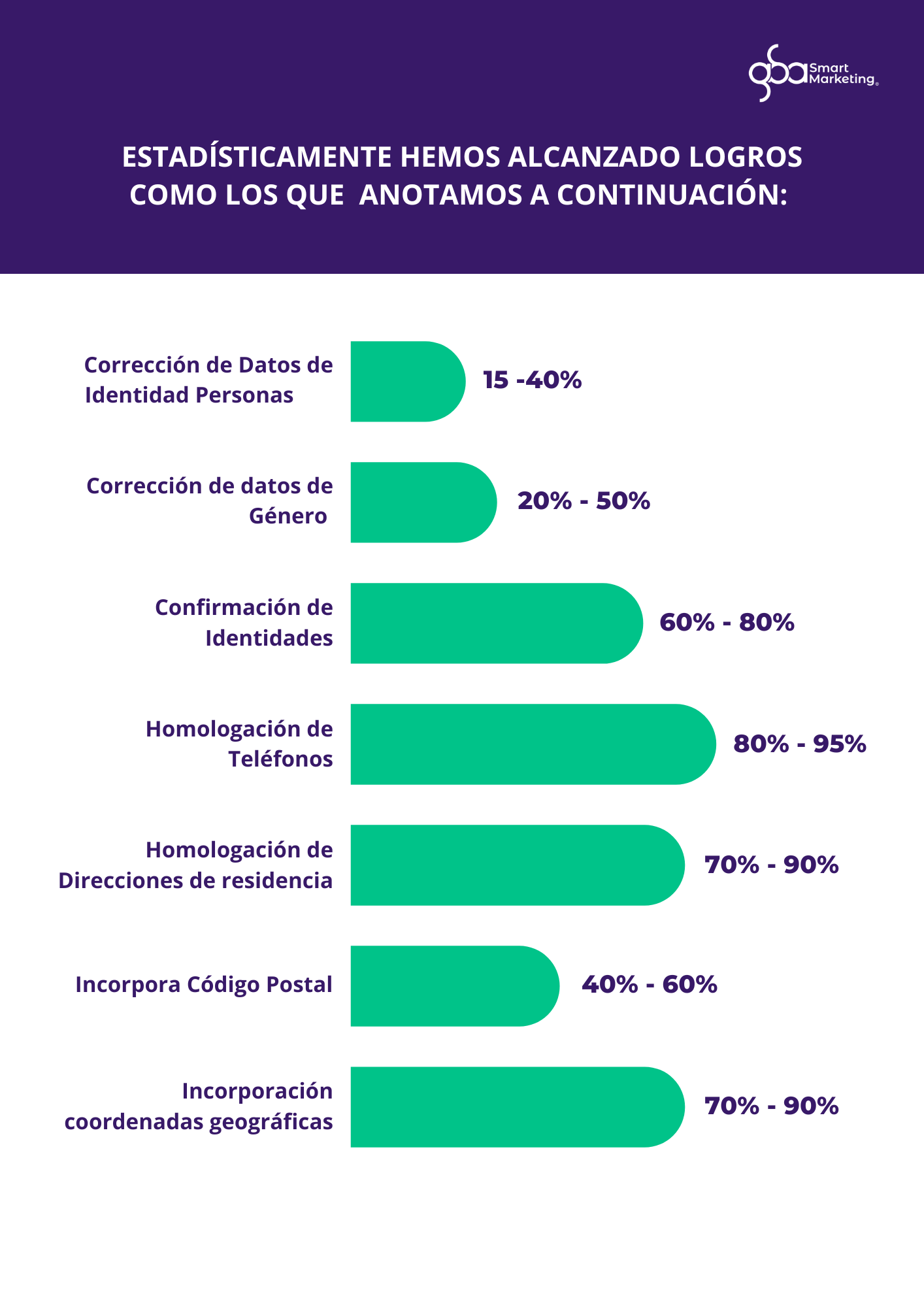
El trabajo con que las universidades pueden iniciar su proceso de gestión de datos es a través de la contratación de servicios como el de remediación de datos de GBA Smart Marketing, que les permitan corregir la información de todos los estudiantes que figuran en su base de datos académica.

La información de calidad, se utilizaría para actualizar los datos de los estudiantes en el mismo sistema de gestión académica.

El servicio que ofrece GBA Smart Marketing incluye las siguientes actividades:

  • Normalización de los nombres de estudiantes para asegurar que los datos tengan el mismo ordenamiento dentro la base de datos.
  • Validación del sexo del estudiante utilizando el nombre del mismo para identificar y corregir la información.
  • Normalización de las direcciones principales reportadas por los estudiantes para asegurar un estándar en el registro y asegurar su correcta lectura y aplicar estándares de nomenclatura tales como:

– Ordenamiento de los datos iniciando con la dirección del predio, después los datos del inmueble (piso, apto, entre otros) la localidad y el barrio. De igual manera se hace para las direcciones que corresponden a sitios rurales.

– Se confirma y verifica la asignación de código de identificación de ciudades aplicando el estándar de la entidad oficial del país.

– Algunas direcciones tienen escrito el nombre del municipio/estado/provincia en la dirección, en esos casos se aísla ese dato de la dirección y se registra de manera codificada.

  • Normalización y estandarización de los números de teléfono de contacto:

– Se identifican los números de teléfonos móviles y teléfonos residenciales.

– Los números de teléfonos móviles se ubican en columnas específicas.

– Se asignan prefijos por ciudad a números de teléfonos residenciales de acuerdo con la nueva nomenclatura colombiana.

  • Enriquecimiento de datos:

– El cruce de datos de identidad de estudiantes y confirmación o corrección de identidad con datos oficiales.

– Combinación de datos de direcciones y obtención de código postal y coordenadas geográficas.

– Cruce de datos de direcciones contra entidades oficiales y obtención de código postal, coordenadas geográficas y localidades.

Data-Driven Mindset


Tendencias emergentes en estrategias comerciales y marketing para este 2023

El 2023 promete ser un año emocionante para las áreas comerciales y de marketing, con nuevas tecnologías y enfoques emergentes que permitirán a las empresas ofrecer una experiencia más personalizada y efectiva a sus clientes. Por ello, analizaremos algunas de las tendencias emergentes en estrategias comerciales y marketing para este año.

La mayor tendencia que observamos es que las empresas se centran cada vez más en el cliente. A medida que los clientes se vuelven más exigentes, es importante que las empresas les proporcionen los productos y servicios que desean. 

Perspectivas en estrategias comerciales y marketing

En los próximos cinco años, las empresas se centrarán en establecer relaciones a largo plazo con sus clientes, ofreciéndoles mejores productos y servicios a menor costo. Esto significa que la experiencia del cliente es fundamental y debe tenerse en cuenta en todos los aspectos de las empresas.

En un estudio reciente de Forrester Research, el 80% de los compradores B2B dijeron que dejarían de hacer negocios con empresas que no proporcionaran una excelente experiencia al cliente. Las empresas que ofrecen experiencias notables se verán recompensadas con clientes fieles que las recomendarán a otros y gastarán más dinero a lo largo del tiempo que aquellas que no ofrezcan una experiencia fluida.

A los clientes ya no les gusta que les traten como números, quieren que les traten como individuos. Personalización significa dar a los clientes exactamente lo que necesitan y quieren en cada paso de su viaje a través de su sitio web o aplicación. Esto puede ser algo tan sencillo como ofrecerles un descuento si comparten su dirección de correo electrónico. O algo más complejo como ofrecerles diferentes opciones en función de dónde vivan o qué dispositivo utilicen para acceder a su sitio web o aplicación. Se trata de personalizar la experiencia para que parezca diseñada exclusivamente para ellos.

  • El auge de la automatización del marketing impulsada por la IA: la inteligencia artificial (IA) existe desde hace décadas, pero no ha sido hasta hace poco que las empresas han empezado a integrarla en sus estrategias de marketing. En 2023, la IA será empleada por el 80% de las empresas B2B para personalizar sus campañas, crear mejores contenidos y aumentar el ROI.
  • Las redes sociales como herramienta de venta: las redes sociales ya no son solo un lugar donde la gente comparte fotos y vídeos o comenta las publicaciones de otras personas, sino que se han convertido en una valiosa herramienta de ventas para las empresas que quieren relacionarse con su público antes incluso de que este se ponga en contacto con ellas por correo electrónico o teléfono.

Vanguardia competitiva

A medida que la economía global continúa evolucionando, las empresas deben mantenerse a la vanguardia para seguir siendo competitivas y exitosas. Esto incluye comprender cómo las estrategias comerciales, de marketing y otras tendencias afectarán sus operaciones. Al tener una comprensión clara de estas tendencias, las empresas pueden asegurarse de estar preparadas para cualquier cambio que pueda surgir en el futuro. 

Por esto, no podemos perder de vista que la revolución digital seguirá a buen ritmo. La tecnología será cada vez más avanzada, los consumidores exigirán más a las marcas y la gente permanecerá aún más conectada que nunca.

Cuáles son esas tendencias emergentes

Estas son algunas de las tendencias que prevemos estarán presentes en las estrategias comerciales y marketing para 2023, entre las cuales se destacan:

  1. Marketing de contenido: El marketing de contenido sigue siendo una estrategia clave para generar engagement y fidelidad en los consumidores. En el 2023, se espera que las marcas sigan produciendo contenido de calidad, relevante y adaptado a los diferentes canales y formatos, como videos, podcasts, infografías, entre otros.
  2. Personalización: Los consumidores cada vez esperan una experiencia más personalizada, y las marcas están adoptando tecnología y herramientas para ofrecer productos y servicios personalizados en tiempo real. 
  3. Inteligencia Artificial: La IA está transformando la forma en que las empresas hacen negocios, se espera que las marcas sigan invirtiendo en esta tecnología para mejorar la eficiencia, la personalización y la experiencia del cliente. La IA también puede ser utilizada para mejorar la segmentación de audiencias y la predicción de comportamientos de compra.
  4. Omnicanalidad: Los consumidores esperan una experiencia de compra fluida y consistente en todos los canales que usan, desde las tiendas físicas hasta las redes sociales.  Lo que indica que las marcas sigan adoptando una estrategia omnicanal para mejorar la experiencia del cliente y aumentar la retención.
  5. Sostenibilidad: La sostenibilidad sigue siendo una preocupación importante para los consumidores y en el 2023, las marcas deben continuar adoptando prácticas sostenibles en su cadena de suministro, producción y distribución. Las empresas también pueden emplear la sostenibilidad como un diferenciador competitivo.
  6. Influencer Marketing: El marketing de influencia sigue siendo una tendencia relevante para las marcas que buscan llegar a audiencias específicas y generar confianza en sus productos y servicios. En el 2023, se espera que el influencer marketing siga evolucionando hacia relaciones más auténticas y duraderas entre las marcas y los influencers.
  7. Automatización del marketing: La automatización del marketing permite a las empresas hacer más eficiente y efectivo el proceso de generación de leads y la gestión de campañas. Invertir en herramientas de automatización del marketing para mejorar la eficiencia y la efectividad de sus campañas será una tendencia irreversible.
  8. Realidad aumentada y virtual: La realidad aumentada y virtual están siendo cada vez más utilizadas por las marcas para mejorar la experiencia del cliente y aumentar la interacción con sus productos y servicios. Por ejemplo, algunas tiendas están usando realidad aumentada para permitir que los clientes prueben virtualmente productos como ropa y maquillaje antes de comprarlos. En el caso de la realidad virtual, algunas marcas están creando experiencias inmersivas para sus clientes, permitiéndoles explorar virtualmente sus productos y servicios en un entorno simulado. 
  9. Comercio conversacional: se refiere a la utilización de chatbots y asistentes virtuales para interactuar con los clientes y facilitar la compra y el soporte. Además, los chatbots pueden ser programados para aprender de las interacciones con los clientes, mejorando con el tiempo su capacidad para proporcionar respuestas precisas y útiles. 
  10. Experiencias de marca inmersivas: son aquellas que buscan involucrar a los clientes en una experiencia que va más allá de la simple compra de un producto o servicio. Esta técnica puede generar mayor engagement y fidelidad en sus clientes. Por ejemplo, algunas marcas están generando instalaciones físicas o virtuales que permiten a los clientes interactuar con sus productos y servicios de una manera única y memorable. Estas experiencias pueden ser compartidas en las redes sociales y generar un mayor alcance y compromiso con la marca.
  11. Marketing basado en valores: Cada vez más consumidores están buscando marcas que compartan sus valores y preocupaciones sociales y ambientales. En el 2023, se espera que las empresas sigan adoptando un enfoque más consciente y sostenible en sus prácticas comerciales, y que lo comuniquen de manera efectiva a sus clientes. Las marcas pueden utilizar su compromiso con la sostenibilidad, la justicia social o la igualdad de género para diferenciarse de la competencia y construir una relación más profunda y significativa con sus clientes.
  12. Marketing de voz: Con el aumento de los asistentes virtuales y la tecnología de reconocimiento de voz, el marketing de voz está emergiendo como una nueva forma de interactuar con los clientes. Las marcas pueden emplear la voz para proporcionar recomendaciones de productos, hacer reservas o responder preguntas de los clientes. Además, las marcas pueden usar la voz para crear experiencias de marca personalizadas, empleando el tono de voz y el lenguaje que mejor se adapte a su público objetivo. 

En un reciente informe de Accenture se menciona que, “la era digital ha llegado a un punto en el que afecta a todos los aspectos de nuestra vida”. 

A medida que las empresas evolucionan y se adaptan a los cambios del entorno, también deben hacerlo sus estrategias. Para tener éxito en los negocios, es esencial seguir el ritmo de los tiempos cambiantes. Las empresas que no adaptan sus estrategias y prácticas a las últimas tendencias corren el riesgo real de quedar rezagadas frente a la competencia. 

Las nuevas tecnologías están transformando la forma en que las empresas hacen negocios. Es importante que los clientes estén al tanto de las últimas innovaciones en su área de negocio. Se debe estar dispuesto a experimentar y probar nuevas herramientas y tecnologías para mejorar la eficiencia, la personalización y la experiencia del cliente. 

Comprender estas tendencias es esencial para cualquier negocio que busque seguir teniendo éxito en los próximos años.

dispositivo-sujecion-mujer-tiro-medio

Optimization of marketing campaigns through customer insights

Marketing campaign optimization through customer insight is a marketing strategy based on collecting and analyzing customer information to improve the effectiveness of campaigns. This strategy involves, among others, the use of data analysis technologies and artificial intelligence tools. To collect information about customer preferences and behaviors, and use this information to adjust and improve campaigns.

In this edition, we will share with you how our client achieved its strategic objective of providing a positive and holistic experience throughout the customer journey. They wanted to get to know their consumers in a comprehensive way, so that, with the good use of this information, it would be possible to increase loyalty, purchase and repurchase of their products. However, obtaining this data alone was not enough.

Optimizing a marketing campaign through insights

Optimizing marketing campaigns through customer insight focuses on personalizing campaigns to reach customers more effectively and efficiently. For example, if you know that a customer has purchased a particular product in the past, you can use this information to present them with relevant ads and special offers related to that product in the future.

By using customer insights to optimize marketing campaigns, companies can improve the relevance and effectiveness of their messages, which in turn can increase the conversion rate and ROI of campaigns. In addition, by personalizing campaigns for each customer, the customer experience can be enhanced and long-term loyalty can be fostered.

Our client: This is an important reseller of a prestigious brand manufacturer of computers and smartphones, with points of sale distributed in the main cities of Latin America, where it has served more than 700,000 customers over the last few years.

The purpose: was to increase the number of transactions, as well as the average ticket of each one of them, but the knowledge of the end customer was scarce, so all campaigns were segmented in a traditional way. For this business challenge, the purpose was to micro-segment, build very detailed profiles and know the motivations and aspirations of the final consumers.

The GBA Smart Marketing® solution

Smart Data, we built for our client a data repository in the cloud, in which we integrated all data sources (online/offline). We then structure, debug and deduplicate this data.

Smart Analytics & Smart Geo: we performed different analytical exercises including: cluster analysis, purchase propensity modeling, demographic and geographic segmentation. The use of artificial intelligence reduced campaign planning execution times and subsequent feedback.

The result of these data and analytical exercises was the detailed definition of at least twelve segments. Within these three sub-segments we were able to describe at least eighteen main attributes.

With all of the above we had two dimensions of analysis: from the transactional and from the point of view of data and geography, understanding their place of residence, pedestrian and vehicular transit. Since the physical points of sale represented for our client their most important sales channel, it was necessary to clearly answer the question: Where?

Smart Contact: With all the inputs collected, we went a step further and diagnosed the potential for contactability and the existence of permissions for the use of personal data.

Through a segmented channel strategy, focused on maximizing response and conversion. We managed to design and execute four types of campaigns during the first year. These campaigns had five objectives:

  1. Capture of data usage permissions.
  2. Increased contactability and first steps in building multi-channel.
  3. Increase purchases within active customers with high-high and medium-high propensity to buy.
  4. Up selling & Cross Selling for customers who made purchases in the last twelve months.
  5. Identification of new customer prospects with high consumption potential.

Results

The results obtained in the first 12 months of implementation of the Single Customer View by GBA Smart Marketing® solution in relation to the previous 18 months were as follows:

  • Increased contactability by email by 21%, by cell phone by 27%, by physical address by 12%.
  • We found 78,635 duplicate prospects in whom we were investing about 3.1% of the communication budget.
  • It was determined that 17.21% of the customer database had inconsistencies in the information recorded, which affected the results of all marketing actions.
  • The number of clients increased by 7.5%.
  • Increased up-selling by 11.1%.
  • Cross-selling increased by 9.7%.
  • The average ticket increased by 3.4%, 7.2% and 8.1% respectively during the last three quarters.

For GBA Smart Marketing®, the value and interpretation of data plays a key role in the development and innovation of our portfolio of tailor-made solutions for each of our clients.

We have different techniques and algorithms that allow us to treat structured, semi-structured or unstructured data. We integrate experience, technology and methodology to implement concepts such as ML, AI & SmallBig Data. These concepts are our pillar in the development of marketing activities, in order to support our clients in achieving their strategic objectives.

Contact us for more information about our services.

gente-negocios-trabajando-computadora-portatil-reunion 1 (1)

Geoanalysis study for an advertising and outdoor communication company

The times in which we live have led advertisers to optimize cost and useful audience. The effectiveness of a solution, as well as ROI, are notions that are more than ever at the heart of media strategies. This requires finding a new balance between power and affinity.

Faced with these challenges, our client wanted to develop a unique method of characterization of advertising devices, which would make it possible to know not only the number of people passing in front of the billboards, but also their life and consumption habits.

Diversity of locations for a geoanalysis study

Geo-analysis makes it possible to examine and better understand the relationship between the geographical location of customers and the consumption patterns of products or services. In this case it turned out to be the tool that aimed to obtain the desired information.

This is because geoanalysis can also identify new growth opportunities and make more informed decisions about site selection and other key business operations.

The Client

A well-known outdoor advertising and communication company, with a global presence and a significant number of advertising devices. It zoned the entire territory and ensured optimal coverage of the population that is present in all public, consumer and mobility spaces.

This diversity of locations allowed it to offer advertisers a wide range of exclusive routes to better meet their communication objectives.

The objective versus the problem

To build such a method, it was necessary to incorporate different elements into the GeoAnalytics and Data Service equation, to cross-reference them with the client’s audience data. Additionally, a high data processing capacity and the construction of statistical models such as profiling and segmentation, among others, were essential.

GBA Smart Marketing® Solution

The answer to our client’s needs was the socio-demographic segmentation that includes, as no other company in Latam, information from Social Networks. This segmentation groups a wide range of very precise data and allows segmenting the totality of the households where the devices are located.

For our client, we analyzed a significant number of advertising spaces with the help of more than 600 criteria from our behavioral databases.

By cross-referencing the databases and the addresses of the billboards, the client had more dynamic criteria at its disposal. This allowed them to analyze each advertising device and its human and commercial environment at a very fine level.

Results

With the exhaustive work of GBA Smart Marketing® and the different partners on which it has relied, the client built a unique solution that allows to make each advertising device more «intelligent».

By cross-referencing geographic and behavioral data, it allows to know, for each advertising device:

  • The number of people passing in front of the billboards.
  • The living and consumption habits of these people.
  • The list of nearby billboards.

Finally, geo-analysis can also help companies identify new growth opportunities. By analyzing demographics, customer spending patterns and other factors, companies can identify areas where there is unmet demand for their products or services.

Another important application of geoanalysis in marketing is site selection. By analyzing data on population density, income levels and other demographic factors, companies can identify the most promising locations for new stores or other facilities. This can help minimize risk and ensure that new businesses locate in areas where they are likely to succeed.

For GBA Smart Marketing®, the value and interpretation of data plays a key role in the development and innovation of our portfolio of customized solutions for each of our clients.

Contact us for more information about our services.

Diseño sin título (50)

Increasing Savings with the Inter-American Development Bank through a single customer view

Despite the fact that in Colombia all workers are obliged to contribute to the social security system, in 2018 35% of employees of private entities and 67% of self-employed workers did not contribute to their pension. This, in part, due to the fact that 44% of Colombians have incomes below the minimum wage and, therefore, the minimum contribution to the system represents a very high percentage of their income. Without sufficient income, many Colombian workers do not have an automatic mechanism to save for their old age.

To improve coverage for this population, in 2015 the Colombian government created the voluntary pension savings program Periodic Economic Benefits (BEPS). When the intervention was designed, in June 2018, BEPS had 1,107,383 linked, of which 352,192 (31.8%) had saved at least once in the program. Moreover, only 19% of those who saved did so consistently: either they had saved in 2017 at least 147,500 Colombian pesos (approx. $115 PPP), or they had made more than six contributions in that year, requirements to access life insurance subsidized by the program in 2018.

From this perspective, we proposed the implementation of Single Customer View (SCV) to allow us to create a complete view of each customer. Integrating all relevant information about their behavior and activity throughout their customer lifecycle.

The Client

From the IDB retirement savings laboratory, the Inter-American Development Bank asked us to develop several processes. Such as, improving the results of linking new savers, increasing the recency of savings, increasing the frequency of savings transactions and improving the average value saved in each transaction. These were the 1.3 million people linked to Colpensiones’ BEPS program (Periodic Economic Benefits).

The program consists of offering people a voluntary savings mechanism for old age, the majority of those linked must be people of low socio-economic levels with an income of less than 1SMMLV (One Minimum Legal Minimum Wage in Force). At the time of the pilot, 68.20% of the portfolio had no savings and 31.80% were considered savers. These are populations with little or no banking coverage, mainly underemployed and informal employees.

The point of focus

The IDB needed to have a comprehensive understanding of its savers, as well as the reasons why other people involved in the program did not save, in order to encourage savings in the most efficient way for both groups.

There are multiple reasons that limit voluntary long-term savings in low-income populations. On the one hand, low experience with the financial sector and lack of knowledge of the program (which in some cases leads to distrust). They may lead many people to prefer to save in financial instruments that are more familiar to them, such as investing in their home, even though the returns on these investments may be lower and more volatile.

On the other hand, psychological biases, most notably inattention, decrease individual willingness to save.

It has been identified that individuals do not have an image of their own old age, especially young populations do not consider it; there are life cycle conditions that facilitate the appearance of this imaginary, so these variables become relevant in the analysis and approach to potential savers.

In order to motivate those linked to the BEPS program who did not save (inactive) to start doing so, and to encourage those who did save (active) to do so more, a strategy of savings incentive campaigns was proposed, executed through different channels, including text messages and high-touch telephone calls, in segments chosen by analysis of massive data (big data) with medium and high propensity to save.

Project Challenges

Low contactability and the impossibility of building multichannel in these groups, a population that, for the most part, changed their mobile number and physical address between two and three times a year.

In addition, we had to take into account a limited budget and the presence of users in more than 1,100 municipalities nationwide. This considerably increased the costs of any face-to-face commercial action that we wanted to propose.

GBA Smart Marketing® Solution:

Single Customer View (SCV).

The task was to increase the number of annual transactions, the average amount saved in each one of them, and to get those who did not save to pick up the habit again. However, we had little knowledge of the customer, which is why all campaigns were segmented in a traditional way and their communication channels were limited to the use of their Contact Center and SMS messages.

We performed a data quality process on the information received from the entity in order to detect outdated and/or inconsistent information. We then updated, complemented and standardized the physical addresses of savers and non-savers, which allowed us to geocode 95% of the database.

Based on the transactional and socio-demographic information and attributes built by GBA Smart Marketing® for the project. Among them, the savings propensity score, income estimator and credit risk score stand out. We were able to segment 100% of the savers and non-savers with more than 51 characteristics for each one.

With the knowledge acquired, we planned and executed differentiated marketing campaigns, through more channels, with messages and frequencies appropriate for each group, maximizing the return on marketing investment (ROMI).

To study the impact of the campaigns, 24,000 program participants were randomly assigned to the pilot, creating a treatment group and a control group, each of which consisted of 6,000 active and 6,000 inactive participants. Since the participants were randomly selected, it was possible to assess the impact of the call campaign on the total number of linkados.

The result:

    • We increased the value saved by 9.47%; the average transaction by 4.11% in the first two months of implementation; the historical number of transactions from 3.31 transactions/year to 5.22 transactions/year; and the contact data update rate by 17.03%.
    • We identified and corrected 17.21% of the database of related parties that presented inconsistencies in the information registered, which affected the results of all marketing actions.
    • We implemented at least 51 new descriptive characteristics that significantly increased the knowledge of the affiliate.
    • We located the areas of concentration of non-members with the highest propensity to save, so that the commercial area of the institution could carry out a more efficient linkage work through its face-to-face brigades with advisory managers.
    • By automating the affiliate journey, we increased the number of campaigns carried out and optimized their management speed.
    • We excluded from marketing management 11.70% of the portfolio of affiliates who had no real possibility of saving.
    • Among the active affiliates, those assigned to the treatment group were 14% more likely (18.41 pp vs. 16.14 pp of the control group) to make contributions in a month and saved 9.4% more per month (approx. US$2.34 vs. US$2.13 of the control group). Thus, among active affiliates, the treatment generated 1.6 dollars of savings for every dollar invested.
    • In the inactive affiliates, although those assigned to the treatment group had a 41% higher probability (0.86 pp vs. 0.61 pp of the control group) of making contributions in a month and saved 46.9% more per month (0.13 dollars vs. 0.09 dollars of the control group), the differences we found are not significant. In other words, the treatment did not generate a significant increase in savings in the inactive affiliates.

Conclusions

High-contact call campaigns in selected groups, using analytical techniques and in accordance with their savings potential, increase the savings of independent and low-income workers, such as those linked to the BEPS program in Colombia. However, their effectiveness depends on whether these workers have already saved voluntarily.

Among those who had already saved, the treatment generated $1.6 in savings for every $1 invested. Among those who had not yet saved, the treatment did not generate significant savings.

One determinant of cost-effectiveness in this case is the price of the calls. Targeting those with a high savings potential allows minimizing the cost of calls while maximizing the potential impact. The savings potential, however, was estimated based on voluntary savings without intervention.

Knowledge of the client through the use of non-conventional variables, or variables that go beyond demographic data, makes it possible to generate personalized campaigns that involve differentiation in the message as well as in the channel and the recipient, maximizing the benefit obtained with the investment. Saving is always possible if it is based on financial education and personalized advice based on an imaginary aligned with the characteristics of the financial product.

Organizations can save money and improve their indicators with a strong investment at the beginning to improve their databases and customer-facing processes, but with a more economical operation in the medium and long term based on updating profiles by observing their reaction to campaigns, their life-cycle changes, emerging events and economic evolution.

For GBA Smart Marketing®, the value and interpretation of data plays a key role in the development and innovation of our portfolio of tailor-made solutions for each of our clients.

Contact us for more information about our services.